
Build the Mathews County Former-Owner Chain Backward
Treat the newest deed as the top of the chain. From there, take the named grantee. Search for the earlier deed in which that same party bought the land. Then repeat. Every link must describe the same tract, so compare legal descriptions before accepting a match. The table below works as a recording worksheet rather than a sample transaction. Fill it only with dates and references you have verified in the instruments themselves. That discipline keeps each former owner tied to the right land. It also guards the chain as parcel labels shift over time.
| Source | Period or coverage clue | Where held | What it can show |
|---|---|---|---|
| Remote SRA/COVERS land-record access | County states remote access begins Dec. 29, 1995 | Virginia courts portal; image access has separate terms | Index references and accessible document images |
| Clerk deed books and counter indexes | Ask the Clerk for the year and series needed | Mathews Circuit Court Clerk | Recorded transfers and instrument references |
| Library of Virginia microfilm | Inventory notes major loss in the 1865 courthouse fire | Library of Virginia | Surviving local record series; completeness varies |
| Mathews land-tax material | Library collection identifies 1801-1818 | Mathews Memorial Library collection | Tax-era clues, not deed transfers |
| Gloucester records | For land before Mathews formed in 1791 | Gloucester County record sources | Earlier jurisdictional land and owner references |
| Transfer point | Grantor to grantee | Instrument type | Book/page or ID |
|---|---|---|---|
| Latest verified transfer | Read from deed image | Confirm in index and instrument | Copy exact reference |
| Prior owner's acquisition | Search latest grantor as grantee | Compare legal description | Copy exact reference |
| Earlier transfer | Repeat with prior grantor | Note corrections or partial interests | Copy exact reference |
| Historic gap or boundary change | Use names and adjoining owners as clues | Check plat, probate, tax, and archive records | Mark uncertainty clearly |
Never plug a tax-list name into a missing row. Treat it as a possible deed transfer and nothing more. A tax entry or directory can point you toward the next source. It cannot prove title the way a recorded deed does. The difference matters most when the chain crosses a gap in the deed series.
Key terms. A grantor conveys an interest and a grantee receives it. A chain of title is the linked series of recorded interests for the same land. Match each party and instrument to the legal description before treating it as a transfer in that chain.
Start a Mathews County Former-Owner Search With the Latest Grantee
Begin in the Virginia Secure Remote Access system with the most recent likely grantee. Mathews County reports that remote land-record access starts December 29, 1995. That date marks the remote system only. It is not the earliest surviving deed book. So check the current SRA coverage notes and date controls before treating it as the start of the county's records.
- Find the latest likely deed and confirm the current grantee and parcel description.
- Search the grantee's name backward as a grantor to identify the preceding transfer.
- Open each instrument and compare names, dates, legal descriptions, and parcel clues.
- When remote coverage stops, ask the Clerk for older books or indexes and check archival sources.
- For pre-1791 land, search Gloucester County records as the earlier jurisdiction.
First, confirm the newest result is truly a deed. A deed of trust, release, judgment, or correction can look similar in an index. Read the full instrument whenever you can. Copy the grantee's exact name. Also copy the capacity, recording date, book and page or instrument number, and the property description. Then flip that name into a grantor search to reach the prior transfer. Mathews County posts $50 per month for remote images with clerk authorization. A subscription may be required. The index and the images are separate access channels. Confirm current terms with the Clerk.
Match the Land Description and Parcel Key at Each Step
Names repeat across generations in Mathews County. So do parcel shapes and identifiers. At every link, compare the legal description, acreage, lot and block, subdivision, and adjoining owners. Pull up the current GIS card to orient yourself and note its Tax Map/Parcel ID. Do not expect an old deed to carry a modern street number. Do not expect an old deed to carry a modern parcel code. Local descriptions may point to roads, creeks, marsh, shore, wharves, or neighboring owners instead. A new plat can replace an older tract description. A boundary adjustment can create a revised parcel. A chain may seem to jump between different descriptions. Look for a partition, corrective deed, family transfer, or recorded plat explaining the shift. A name may match but the land may not. Keep that person out of the chain. Treat them as a separate candidate until a document connects them.
Remote Coverage Is Not the Same as Record History
The Clerk's page lists December 29, 1995 as the start of remote land-record access. It says nothing about the oldest deed the office holds. Nor does it give a full date range for the free index. An older entry may appear online anyway. Paper and microfilm may also reach beyond what remote search returns. Ask the Clerk how a given book, page, or year is indexed. For a pre-1995 transfer, leave the SRA search. Move instead to the Clerk's counter indexes and deed books. Library of Virginia microfilm or a local archive is the next stop when the Clerk directs you there. Track which source you searched and the span it covers. A blank remote result is not proof that no prior owner existed. When you contact a custodian, include the known parties, likely years, parcel key, and the reference from the next deed in the chain. That focused request works far better than an open-ended surname search.
Mathews County Former-Owner Gaps After the 1865 Courthouse Fire
A courthouse fire in 1865 destroyed most of Mathews County's early records, according to the Library of Virginia's microfilm inventory for the county. Some items survived. Others were rebuilt later. That loss left a mark. Because of it, the county's historic deed chain rarely runs complete in a single series. When a former-owner search hits a gap, treat it as a puzzle. Loss is one explanation. Other causes exist. An indexing difference, a jurisdiction change, or a transfer recorded in a different legal form can also produce a blank spot.
Mathews County split from Gloucester County in 1791. Land transactions before that year sit in Gloucester records. The older county is the natural first stop for early parcels. For gaps after formation, set the surviving deed books beside court papers, probate files, tax lists, plats, family papers, directories, and newspapers. Each source can place a name or parcel in time. Only some of them prove a conveyance.
The official Library of Virginia microfilm inventory describes the county collection and its loss history. The catalog page shows what the repository holds.
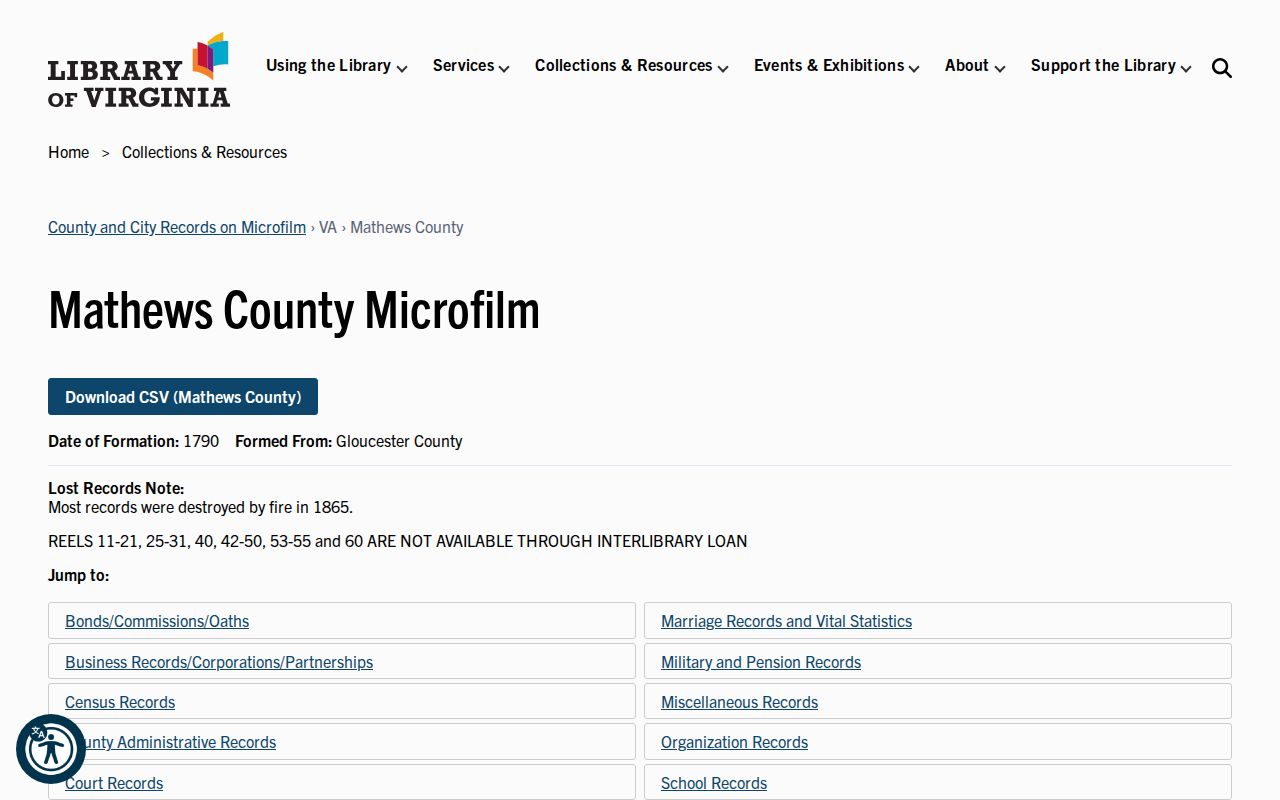
Let the inventory shape your list of candidate material. Then ask the repository directly what survives for the record type and years you need.
Library Land Taxes Help Trace Mathews County Former Owners
Mathews Memorial Library lists local land-tax material covering 1801 through 1818 in its history collection. A tax roll can anchor a family or landholder to a stretch of years. It can point toward a deed, a probate file, or a neighboring tract. But read it for what it is. A tax list may not name every owner. It may not fix an exact boundary. It also may not prove how a transfer happened.
The library's holdings go further. Directories, newspapers, archive materials, and databases all appear in its catalog. The county genealogy page points to the records room and other repositories. Access rules differ by item, database, and library card. Before treating any lead as a title fact, ask staff for guidance. Learn which catalog entry or archival collection is likeliest to hold your name or year.
The Mathews Memorial Library collection page describes these local resources. The archive and genealogy page displays the full range of holdings.
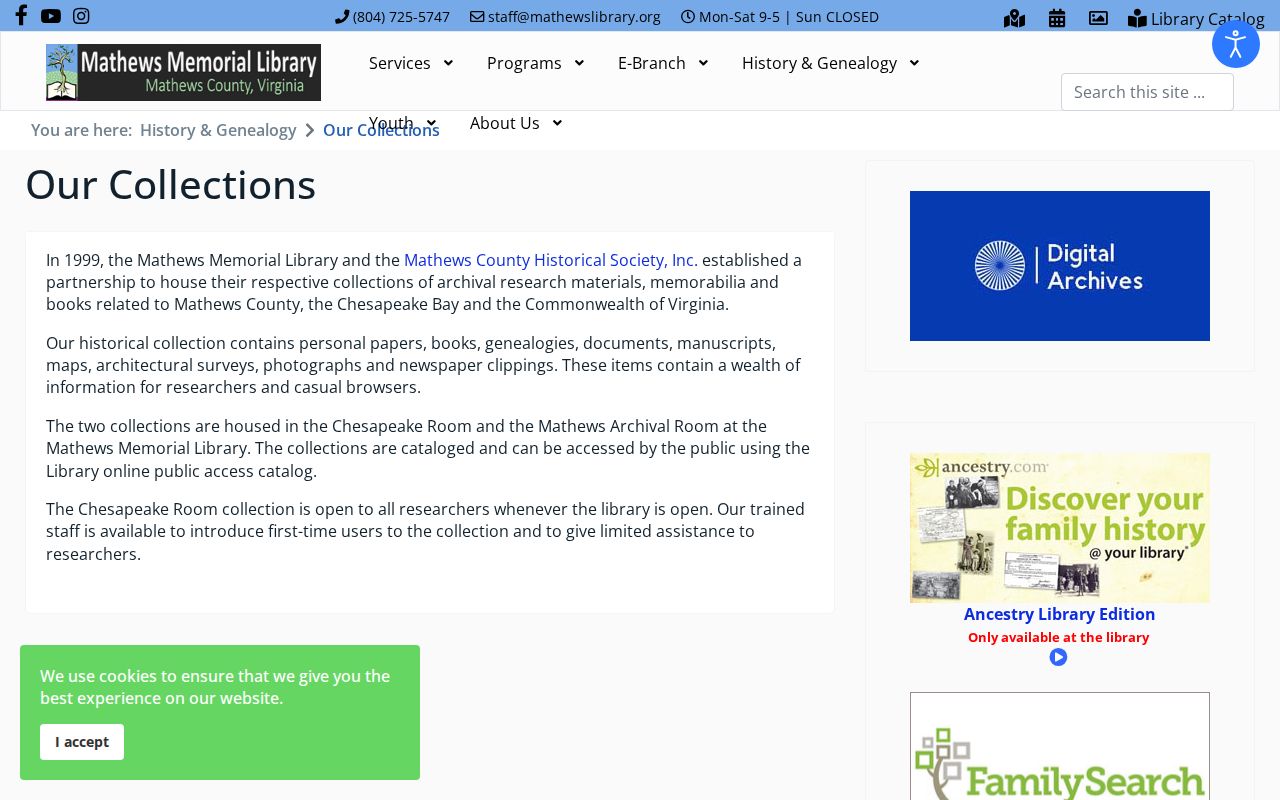
Treat tax lists as leads. Follow each one with a deed, probate record, plat, or other source that proves the chain link.
Search Gloucester for Mathews County Former Owners Before 1791
Mathews County was formed in 1791. That date matters for any parcel whose recorded history starts earlier. A conveyance from before the split may live in Gloucester County records instead. Search the older jurisdiction using historic owner names and the land description. Then carry the reference forward into later Mathews deeds.
Place names can mislead you. The county-seat community appears as Westville, Mathews Court House, or simply Mathews in older material. A deed or directory may use a village or road name. That name may no longer match the postal address. Run those variants through deed indexes, directories, and newspapers. Before accepting a match, confirm the land description ties the entries to one tract.
Holdings differ by institution. The Library of Virginia, the county records room, and the Historical Society each offer something distinct. A clerk's recorded land instrument remains the proof of transfer. An archive supplies context or helps locate a missing reference.
Probate and Estate Transfers Can Break a Simple Chain
Not every family change shows up as a sale deed. A death can trigger probate. It can also trigger an executor's deed, a fiduciary transfer, or a later conveyance by heirs. The Circuit Court Clerk holds wills and probate records alongside land instruments. So search court material whenever a deed chain stops at someone who died. The same applies when the next grantee is an estate or a fiduciary.
Read each party's capacity closely. An executor conveys for an estate. A trustee can hold or transfer an interest under a governing instrument. A will or probate order may explain where the authority came from. But match the resulting deed against the parcel description. A shared family name never proves that every descendant inherited the same land.
Virginia vital records carry access limits. Birth records become public after 100 years. Death, marriage, divorce, and annulment records open after 25 years, subject to exceptions. The state vital index helps with genealogy. It does not replace probate or land records.
Plats Can Explain Mathews County Former-Owner Description Changes
A chain can look broken for simple reasons. One tract may have become several lots. Or a line may have moved. Search for subdivision plats, boundary-adjustment instruments, and line vacations. Look for family transfers too, and the deeds tied to them. Planning and Zoning keeps the application forms. The Clerk records the deeds and plats. A filed application alone does not prove an adjustment was ever approved or recorded.
Compare the details across documents. Lot number, block, acreage, adjoining parcels, roads, and water features all matter. A plat shows the source tract and its new lot labels. The deed says which lot or interest actually changed hands. One document may cite a map book or deed book. Follow that cross-reference to the associated record.
For a disputed line or acreage, get a current survey. A historic plat evidences a recorded layout. It is not a measure of every feature on the ground today.
Mathews County Former-Owner Research Needs the Instrument Image
An index entry only points you to a document. The instrument image holds the details that matter in Mathews County former-owner work. Those details include the legal description, any exceptions, signatures, exhibits, and the recording data itself. Read the full page set before drawing conclusions. An index line may not list every party, each parcel cross-reference, or the consideration. So treat it as a starting point rather than the whole story.
Need the image itself? Ask the Clerk about remote access or visit the office in person. The Circuit Court Clerk keeps weekday hours until 4:00 p.m. Recording stops at 3:45 p.m. Copy fees and access rules change, so confirm them directly. For an older chain of title, ask whether a deed book or microfilm reference exists for the years you need.
Remember that even a complete chain is not a title opinion. If your Mathews County deed records search will guide a purchase, sale, or legal action, have a qualified title professional review the full record first.
History limit. Use owner-history research to understand a property's record trail. It is not a person-finding service or a substitute for title work when a legal decision depends on the result.