
Mathews County Property Tax Records Use Fair-Market Assessment
Mathews County assesses real estate at 100 percent of fair market value. That is the standard for the tax roll. It is not a promise of a sale price. The figure exists for the property-tax system. An actual sale is evidenced by transaction records, and the deed may state consideration separately.
| Record or field | What it can show | Where to verify |
|---|---|---|
| Assessed land, improvements, or total | Tax valuation components, if shown on the current card | Commissioner of Revenue; exact card labels need live confirmation |
| Tax bill, receipt, or balance | Amount due or payment status for a tax year | County Treasurer; a public search portal was not confirmed |
| Relief application or status | Information used for an available relief program | Current county form and the responsible tax office |
| Recorded sale instrument | Transfer parties, land description, and consideration if stated | Circuit Court Clerk's SRA index and instrument image |
Key terms. Assessed value is the county figure used for taxation; market value is a sale-value concept under stated conditions. A levy or mill rate is a tax rate applied to taxable value, and a tax lien is a recorded claim related to unpaid taxes. The research did not confirm a Mathews homestead-exemption program, so check current county relief materials rather than assuming one applies.
The county's Real Estate page is the official route to Mathews County assessment. It also covers GIS property-card resources. The official Mathews County Real Estate page summarizes the assessment rule. It also lists the six-year reassessment schedule. Confirm labels with the Commissioner of the Revenue. A displayed card may not carry the complete tax account or payment history. Use it to reach the county source. Then verify any parcel-specific amount with the office directly.
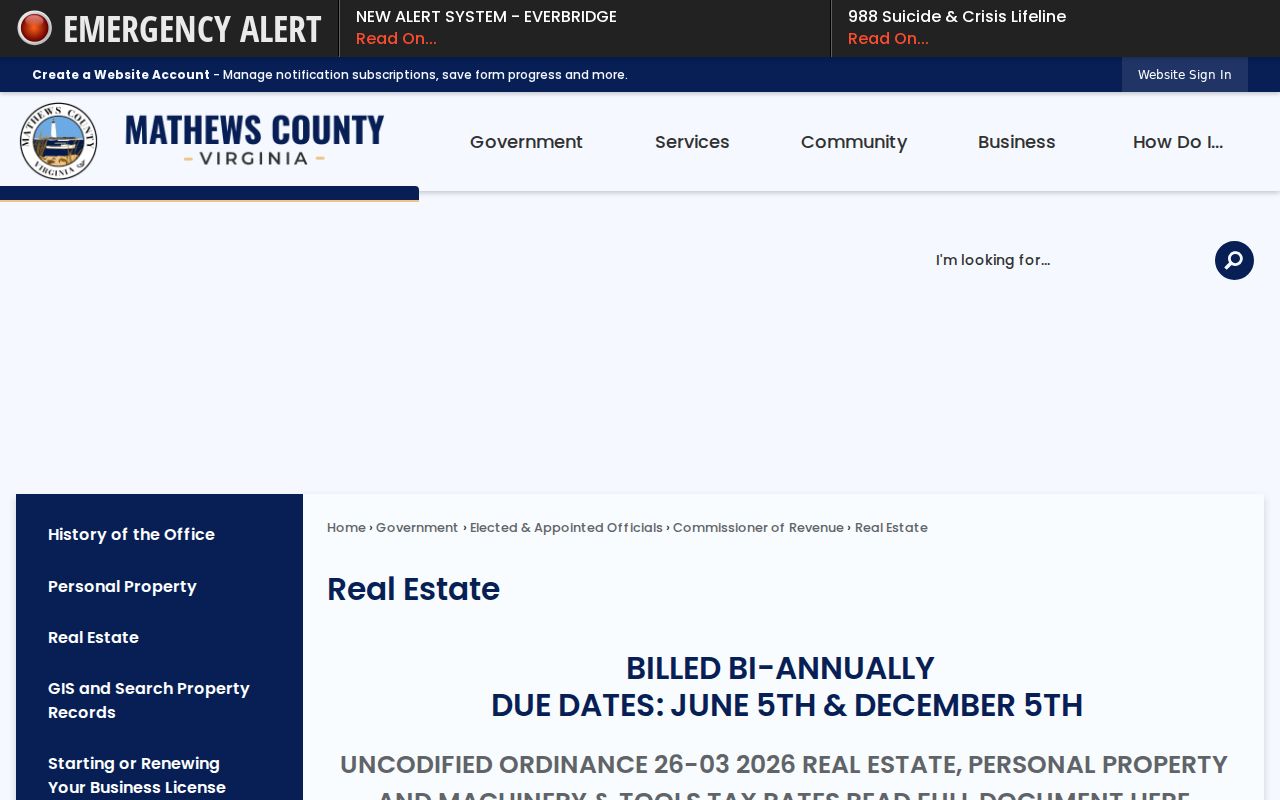
Use the page to reach the county source, then confirm the parcel-specific amount with the Commissioner.
Mathews County Property Tax Records Follow a Six-Year Cycle
Mathews County runs a general reassessment every six years. That cycle matters when you compare two assessment years. One figure may simply be part of a general review. A change between cycles can trace to a parcel event or a correction. Current county material covers 2026 tax and reassessment information. Never infer the reason for a difference from the number alone. Check the assessment notice and the county's explanation. Also check the parcel record and any recorded change affecting the land.
A sale, a new improvement, a change in acreage, a split, or a consolidation can each move a card's numbers. So can a data correction. Confirm the treatment of an individual parcel with the Commissioner of the Revenue.
Track values with care. Keep each year's land, improvement, and total figures together. If the current portal omits history, ask whether earlier assessment records are available on request.
Due Dates for Real-Estate Taxes in Mathews County
Real-estate taxes in Mathews County come due June 5 and December 5. The Treasurer handles bills, payment status, and collections. The Commissioner of the Revenue handles assessments. The roles are related but distinct. A question about why land is valued a certain way belongs to the assessment office. A question about a posted payment or balance belongs to the Treasurer.
The county publishes no public tax-bill lookup or delinquent parcel search. The GIS viewer displays no bill history either. Start with the Treasurer's office or the county's real-estate page. Ask how to retrieve a specific bill. Give the tax-map number and tax year if you have them.
A due date says nothing about whether an account is paid. Confirm the parcel's current status with the Treasurer before relying on any balance assumption.
Land and Improvement Values in Mathews County Property Tax Records
A property card splits value into parts. The land component carries one figure. Buildings and other improvements carry another. A combined total rounds out the tax roll. Not every viewer exposes all three fields. So treat them as a checklist when you open a live Mathews County record. The card may also tie the assessment to an address, tax-map number, acreage, legal description, tax district, last sale, exemption flags, and building details. Confirm which items the current viewer actually shows. If a number or date matters, ask the Commissioner of the Revenue how it was assigned. Note which year it covers.
Value fields are not interchangeable. The land value reflects the taxable land component. An improvement amount reflects assessed structures. The total is a roll figure used for the tax bill. A transfer price belongs to a deed or other sale record instead. A deed may reflect rights or conditions that assessment components never show.
Read the card with that split in mind. A parcel's story sits across the assessment, the deed, and the tax roll. Comparing them tells you far more than any single number.
New Work in Mathews County Property Tax Records
Mathews County building forms gather the details that shape a project. Use, work type, square footage, bedrooms, bathrooms, stories, foundation, estimated completion, and estimated cost all appear on the application. The same paperwork covers new dwellings, additions, renovations, manufactured homes, demolitions, pools, accessory structures, and marine structures. Filling out the form only submits information to the Building Department. It does not prove an improvement was finished. It does not prove the assessment record changed either.
An assessment shift after construction has a paper trail. Ask the Commissioner which record supports the new value. Ask Building or Planning for any existing permit files. The county form is a submission process, not a public permit-result search, and Mathews County publishes no fixed timetable for when new work appears in the assessment roll.
One habit prevents mix-ups. Use the same parcel identifier on the building form, the county card, and the map, so a project is never confused with a nearby address or a separate lot.
Relief Programs in Mathews County Property Tax Records
Mathews County publishes real-estate tax relief material for elderly or disabled residents and for veterans. The county's packets request owner and mailing information. The veteran form also asks about principal residence. Exact requirements, deadlines, supporting documents, and household rules live in the current county application. Read it closely before applying. Never decide eligibility from an owner field or a parcel value on a tax card.
Relief changes the tax calculation or the amount due under the program. It does not change who holds title or rewrite a deed. A card may show a relief or exemption flag. Confirm its meaning with the Commissioner or the Treasurer. Confirm its period too. March 15 serves as the deadline for one relief category. The applicable program and the current year's form should be checked before anyone plans around it.
Keep the assessment, the relief application, and the bill as separate records. Each has its own custodian and may disclose different facts.
Finding a Mathews County Tax Bill
The Treasurer is the first stop for a current bill, a receipt, payment status, or a delinquency question. Mathews County offers no searchable property-tax bill portal with sample results. The county property page and the Commissioner resource are useful entry points, but they do not put all billing data online.
- Identify the parcel with its Tax Map/Parcel ID or situs address.
- State the tax year and whether you need a bill, receipt, balance, or payment history.
- Ask the Treasurer which record is available and whether it can be retrieved online or by request.
- If a record is not routinely posted, describe it in a focused Virginia FOIA request to the correct custodian.
When asking for a record, identify the parcel by tax-map number or address. State the tax year. Say whether a bill, paid receipt, balance, or account history is needed. If the information is not routinely posted, Virginia FOIA allows a request for an existing public record. The request just needs reasonable specificity. The public body must respond within five working days or send written notice of an extension. Charges may cover actual costs.
Never send payment details or sensitive personal data through an unverified link. Follow the county Treasurer's current instructions for account questions.
Mathews County Assessment Compared With a Sale Price
The assessment is the county's tax value under its 100-percent fair-market-value rule. A sale price is transaction evidence that may appear in a recorded deed or related instrument. A market value estimate is a separate opinion built on comparable property and conditions. The three figures can differ. A sale can include repairs, access, waterfront rights, unusual terms, or a parcel configuration that a tax card never shows.
Comparing numbers takes care. Capture the assessment year and its components. Locate the most recent deed or transfer record. Then verify that both records describe the same land. A parcel split, boundary adjustment, or legal-description change can make two numbers look comparable when they actually apply to different acreage.
For a sale or lending value question, use an appraisal professional. For ownership, rely on title work. The county's tax figure is useful context, not a substitute for either.
Request Mathews County Property Tax Records Under FOIA
Start by identifying the likely custodian. The Commissioner of Revenue maintains assessment information. The Treasurer handles bills and collections. The Circuit Court Clerk holds deeds and plats. Building and Planning keep their own permit and zoning files. A Mathews County request sent to the wrong office can delay a property search.
Under Virginia FOIA, a request should describe existing records with reasonable specificity. Name the parcel, tax year, type of record, and preferred format when known. The agency's response is due within five working days. Otherwise, it must provide written notice of an extension. Charges may reflect actual costs, not an arbitrary access fee.
An assessment decision needs a different route. Use the county's appeal instructions and calendar instead. Do not treat a FOIA request as an appeal. The county publishes assessment appeal material. Parcel-specific steps and current deadlines should be confirmed with Mathews County directly.
Limits of Mathews County Property Tax Records
A Mathews County tax record tells you what the assessor valued a parcel at. That covers one tax year. That is its job. It does not settle every ownership question, list each easement, or place a surveyed boundary line. The tax roll can also lag behind a fresh deed. The county publishes no fixed update schedule. So the newest recorded deed is the right record for a transfer. The assessment roll is not. A survey and the legal description settle a boundary. The Treasurer confirms what a bill truly owes.
The six-year reassessment cycle and local due dates give Mathews County property tax records a helpful frame. They still cannot replace a parcel-specific explanation from the county itself. Keep a copy of any record you rely on. Note its year before weighing it against a later card or transaction.
Assessment review timing. The available research does not establish the current appeal board, filing method, or deadline for a parcel-specific assessment challenge. Read the current county notice and confirm the review route and date with the Commissioner of Revenue before the stated deadline; tax due dates are separate from assessment-review dates.